1. Industry Background and Market Demand
Before the 1990s, China’s low-voltage distribution equipment industry faced prominent technical bottlenecks, with most mainstream switchgear products suffering from low breaking capacity, poor thermal and dynamic stability, and single electrical configuration schemes. Outdated product structures and inconsistent manufacturing standards restricted the safe and efficient operation of industrial
power distribution systems, failing to meet the expanding power supply demands of industrial plants, power generation facilities, and commercial infrastructure.
To drive technical iteration and standardization of the domestic low-voltage distribution industry, the former Ministry of Energy launched a targeted low-voltage complete switchgear R&D project in 1991. The project was jointly developed by the National Low-voltage Switchgear R&D Team (NLS), aiming to replace backward traditional equipment with standardized, high-reliability, and versatile low-voltage distribution solutions. After provincial-level technical appraisal organized by the Ministry of Energy in October 1992, the GGD type AC low-voltage distribution switchgear was officially put into industrial promotion. Decades of market verification have made this equipment a mainstream conventional product in the domestic low-voltage distribution field, with stable market demand stemming from industrial upgrading,
power grid renovation, and supporting construction of new power stations.
2. Core Concept and Key Technical Principles
The GGD low-voltage fixed switchgear set is a standardized closed-type low-voltage power distribution device designed for 50Hz AC power systems. Its core technical design focuses on balancing system safety, operational flexibility and structural stability, centering on two key indicators: dynamic thermal stability and short-circuit breaking performance.
Different from customized non-standard switchgear, the product adopts a modular electrical design framework. It realizes flexible matching of primary and secondary circuit schemes through standardized component interfaces and circuit combinations, adapting to diverse power distribution scenarios such as power transmission, lighting power supply and terminal power control. The core technical logic is to improve the overall tolerance of the distribution system to short-circuit impact and load fluctuation through optimized busbar layout and component configuration, while simplifying equipment assembly and later maintenance procedures.
3. Product Structure, Performance, Materials and Manufacturing Process
3.1 Structural Design
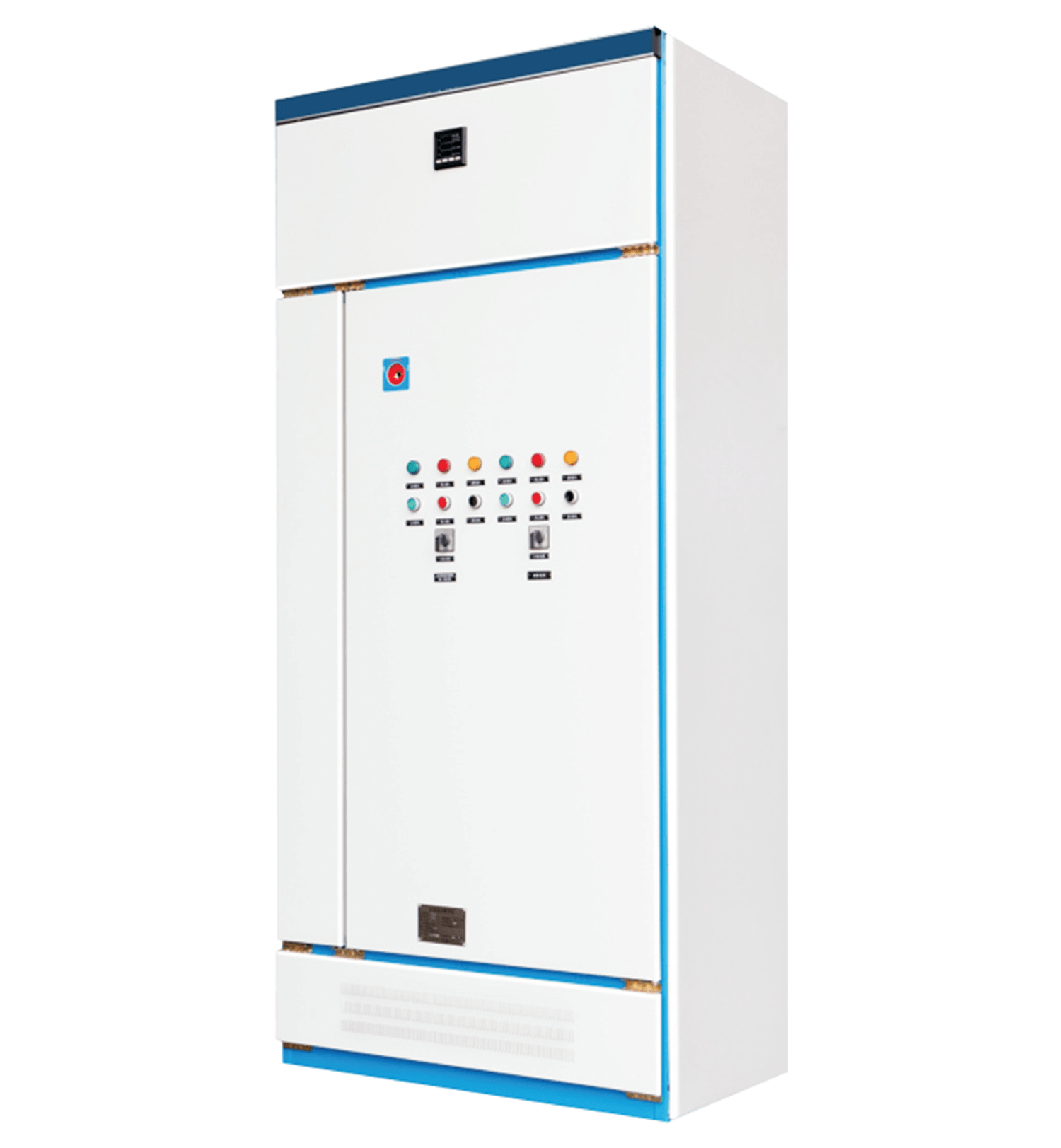
The equipment adopts a fully enclosed metal cabinet structure with an integrated frame design, divided into three independent functional areas: busbar chamber, component installation chamber and wiring chamber. The partition structure effectively isolates high-voltage live parts and control components, reducing the risk of electrical short circuit and accidental contact. The cabinet body supports modular assembly, and functional units such as incoming line, outgoing line and compensation can be freely combined according to on-site power distribution requirements.
3.2 Core Performance Parameters
Applicable to AC 50Hz power systems with rated working voltage of 380V and rated working current up to 3150A. It features high short-circuit breaking capacity and excellent dynamic and thermal stability, which can withstand instantaneous impact current generated by system short-circuit faults and avoid cabinet deformation, component burnout or system tripping caused by current surge. In addition, the product has strong scheme adaptability, with dozens of standardized electrical schemes covering most conventional low-voltage distribution needs.
3.3 Main Materials
The cabinet body is made of high-quality cold-rolled steel plate with a thickness of 1.5mm to 2.5mm, which has high structural rigidity and anti-deformation ability. The internal busbar adopts T2 red copper with high conductivity and low resistivity, which ensures low heat generation during long-term high-current operation. Insulating parts are made of flame-retardant epoxy resin and ABS engineering plastics, with high temperature resistance and electrical insulation strength, meeting national and international flame-retardant safety standards.
3.4 Manufacturing Process
The cabinet body adopts numerical control stamping and bending integrated molding process, with precise hole position and assembly size to ensure the fit tightness of structural parts. The surface is treated with electrostatic spraying and anti-corrosion phosphating, which improves outdoor and indoor environmental adaptability and delays equipment aging. Internal busbars are processed by integral cutting and polishing, with crimping and welding processes optimized to reduce contact resistance; all electrical connections adopt standardized torque fastening technology to avoid loose wiring caused by long-term vibration.
4. Key Factors Affecting Product Quality and Performance
The operational stability of GGD low-voltage distribution switchgear is mainly restricted by three core links: material quality control, process precision and electrical matching design. First, the thickness and material purity of copper busbars directly determine the equipment’s thermal stability; inferior copper materials will increase operating heat generation and reduce short-circuit resistance. Second, cabinet processing precision affects structural stability – excessive assembly gaps will lead to dust accumulation and damp insulation, triggering hidden electrical faults.
In addition, electrical scheme matching is a key human factor. Unreasonable selection of
circuit breakers, contactors and other components, or mismatched load current parameters, will reduce the equipment’s breaking capacity and operational safety. On-site installation and wiring specifications also affect long-term performance; irregular wiring layout may cause electromagnetic interference and affect the stability of secondary control circuits.
5. Supply Chain and Supplier Selection Criteria
The core supply chain of GGD switchgear covers cabinet processing, conductive components, low-voltage electrical appliances and insulating materials. For end manufacturers, supplier selection focuses on stability of material performance and standardized production capacity. For key components such as copper busbars and low-voltage circuit breakers, suppliers must have national electrical product certification and complete performance test reports, with stable material batch consistency.
For cabinet processing suppliers, the core assessment indicators include numerical control processing precision, anti-corrosion process level and product dimensional consistency. For supporting insulating materials and hardware accessories, suppliers need to meet flame-retardant, high-temperature resistant and anti-aging industry standards. In addition, priority is given to suppliers with standardized production workshops and complete quality inspection systems to avoid performance differences caused by non-standard processing.
6. Industry Pain Points and Common Operational Problems
6.1 Industry Pain Points
As a mature conventional product, the main industry pain point of GGD switchgear is homogeneous competition in the low-end market. A number of small manufacturers reduce production costs by cutting material thickness and using inferior accessories, resulting in uneven product quality and affecting the overall industry reputation. Meanwhile, the traditional fixed structure leads to inconvenient later equipment expansion and transformation, which cannot fully adapt to the rapid upgrading of intelligent power distribution systems. In addition, the manual wiring process of individual links leads to inconsistent product quality, relying heavily on construction experience.
6.2 Common Operational Problems
In actual operation, equipment aging and heat dissipation failure are the most common problems. Long-term high-load operation will cause oxidation of busbar contacts, increased contact resistance and abnormal heat generation. Dust and moisture accumulation in the cabinet in harsh industrial environments will reduce insulation performance and easily cause leakage and short-circuit faults. In addition, unreasonable on-site load matching will lead to frequent tripping of protection components and affect the continuity of power supply.
7. Application Scenarios and Industry Cases
GGD low-voltage distribution switchgear is widely used in 380V low-voltage distribution systems of various industrial and public infrastructure projects, mainly undertaking electric energy conversion, distribution and equipment control functions. In the
power industry, it is applied to auxiliary power distribution of thermal power plants, hydropower stations and regional power grid substations, providing stable power support for power generation and transmission auxiliary equipment.
In the industrial field, the equipment is widely used in mining, chemical, manufacturing and other factory production lines, serving power distribution for production equipment, workshop lighting and auxiliary facilities. In commercial and civil infrastructure, it is used for power distribution control of industrial parks, municipal buildings and logistics parks. Relying on its stable performance and flexible combination, the equipment has become the preferred conventional switchgear for most medium and low-power distribution projects.
8. Current Industry Trends and Future Development Direction
At present, the low-voltage switchgear industry is developing towards intelligence, lightweight and high environmental adaptability. Traditional GGD products, based on mature structural design, are undergoing targeted technical upgrades. The original fixed and non-intelligent design is gradually optimized by embedding intelligent monitoring modules, realizing real-time monitoring of cabinet temperature, current, voltage and fault alarm functions, which makes up for the defect of passive operation and maintenance of traditional equipment.
In terms of manufacturing, the industry is promoting refined and intelligent production, replacing manual processes with automated wiring and integrated assembly to improve product consistency and yield. In the future, with the development of new energy power distribution and smart grid construction, GGD switchgear will further optimize environmental protection and energy-saving performance, adopt low-loss conductive materials and efficient heat dissipation structures, and adapt to low-carbon and intelligent power distribution system requirements while maintaining its original high stability advantages.
9. FAQ
Q1: What is the core advantage of GGD switchgear compared with other low-voltage switchgear such as MNS?
A1: GGD adopts a fixed cabinet structure with higher structural rigidity and better dynamic thermal stability, suitable for industrial scenarios with large load fluctuation and high short-circuit risk. Compared with drawer-type switchgear, it has lower manufacturing and maintenance costs, simpler structure and higher operational stability, and is more suitable for conventional large-scale power distribution projects.
Q2: What environmental conditions are suitable for the long-term operation of GGD low-voltage distribution switchgear?
A2: The equipment is applicable for indoor operation, with a suitable ambient temperature range of -5℃ to +40℃, and requires non-condensing, non-corrosive and non-explosive gas environment. It can adapt to conventional factory and substation indoor environments, but needs additional dust-proof and moisture-proof treatment in harsh environments such as chemical plants and coastal humid areas.
Q3: Can GGD switchgear be modified for intelligent upgrading?
A3: Yes. The equipment has a reserved internal installation space, which can be embedded with power monitoring instruments, fault detectors and remote communication modules to realize real-time data collection and remote operation and maintenance functions, meeting the upgrading requirements of smart power distribution systems.
Q4: What are the key maintenance items for daily operation?
A4: Daily maintenance focuses on three key points: regular cleaning of internal dust to ensure heat dissipation and insulation performance; regular inspection of busbar joints and fastening bolts to prevent loose heating; regular calibration of protection components to ensure accurate fault tripping and protection functions.

 RELATED
 RELATED
 RELATED
 RELATED

 English
 Pусский
 中文
中文 қазақ
қазақ



 واتس اب
 هاتف
هاتف